
The Radiation Oncology Center at Virginia Cancer Specialists
Virginia Cancer Specialists offers medical oncology, radiation oncology, musculoskeletal tumor surgery, thoracic surgery, breast surgery, genetic counseling, nutritional counseling, financial counseling, social/ emotional counseling, support groups, and patient education.
Our multidisciplinary team of physicians, surgeons, nurse practitioners, physician assistants, oncology nurse navigators, oncology infusion nurses, oncology pharmacists, laboratory technicians, and many more work together to deliver optimal and efficient patient-centered cancer care.
Radiation Therapy, a Targeted Treatment Option
Radiation oncology is the branch of cancer treatment that uses advanced radiotherapy delivery methods to target and treat a wide range of malignancies. At Virginia Cancer Specialists, our physicians use advanced treatment planning systems and state-of-the-art radiation technology, in addition to a growing list of targeted radioisotopes to deliver treatment that is safer, faster, and more precise than ever before. Our highly trained staff works diligently to make your total experience as convenient and comfortable as possible.
Common Cancers Treated with Radiation Therapy
Bladder
Bone
Brain
Breast
Esophageal & Gastric
Head & Neck
Lung
Lymphoma
Multiple Myeloma
Pancreas
Prostate
Rectum and Anus
Skin
Sarcoma
Spine
Uterine
How does radiation therapy work?
Radiation therapy works by causing DNA damage in cancer cells that cannot be repaired and leads to cancer cell death. It can be given externally or internally, depending on the type and location of the tumor.
External radiation is delivered by a machine called a linear accelerator that generates high-energy beams that are precisely directed into the tumor. External beam radiotherapy is delivered over several days or many weeks depending on a variety of factors.
Internal radiation therapy, also known as brachytherapy, uses radioactive sources that can be temporarily inserted or permanently implanted in the operating room. Radiation from the implant travels only a short distance, which spares most tissues from treatment side effects.
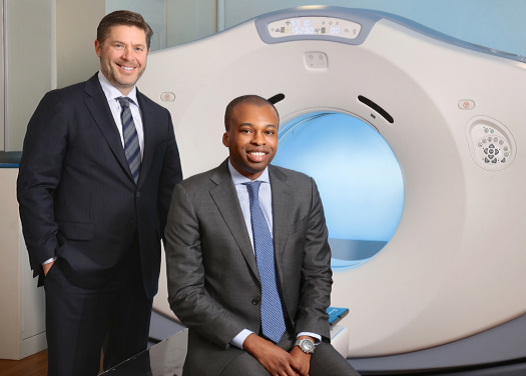
Gregory S. Sibley, M.D. and Harold C. Agbahiwe, M.D. – Radiation Oncologists
What makes care at Virginia Cancer Specialists unique?
The Center for Theranostics Research at Virginia Cancer Specialists, a Center of Excellence
Virginia Cancer Specialists is the proud home to The Center for Theranostics Research, a state-of-the-art facility dedicated to revolutionizing cancer treatment through the ranostics. This cutting-edge approach integrates imaging and therapy to precisely target cancer cells using specialized drugs called radiopharmaceuticals.
The Center brings together leading clinical and research experts, offering patients access to the latest cancer treatments. It is one of a few community oncology practices in the country offering theranostic trials—positioning the Center as a leader in this emerging field.
Led by accomplished radiation oncologists Gregory S. Sibley, MD, and Harold C. Agbahiwe, MD, the Center’s theranostic clinical program—one of the largest programs of its kind in the U.S.—delivers hundreds of radiopharmaceutical treatments and sets national standards for safety and quality.
Sibley and Agbahiwe’s expertise and contributions to the field have earned the Center the recognition as a Center of Excellence by the Society of Nuclear Medicine and Molecular Imaging (SNMMI), recognizing its expertise in radiopharmaceuticals and strict adherence to safety and quality standards. The team also actively contributes to professional societies, publishes research, speaks at conferences, and supports other institutions in developing theranostic programs.
Under the leadership of Alexander I. Spira, MD, PhD, FACP, FASCO, the theranostic research program is home to one of the region’s first radiopharmaceutical trials to introduce alpha-therapy for treating neuroendocrine tumors. Since that milestone, the program has grown significantly expanding beyond its initial focus to include multiple active trials across a broad spectrum of cancers. Research efforts continue to explore new applications for radiopharmaceuticals, combination approaches with other therapies, and advanced technologies like alpha particles for more precise and potent cancer cell destruction. These pioneering efforts position the Center as a flagship research hub, driving innovation and expanding treatment possibilities for patients.
Stereotactic Radiosurgery (SRS) and Stereotactic Body Radiation Therapy (SBRT)
The Radiation Oncology Center at Virginia Cancer Specialists offers both SRS and SBRT in order to deliver extremely precise doses of radiation to cancer cells while minimizing damage to healthy tissue. Stereotactic Radiosurgery (SRS) treatments use high-precision, accuracy, and sophisticated 3D imaging to deliver radiation in as little as a single treatment. Stereotactic body radiation therapy (SBRT) delivers precise radiation for the treatment of small-to-medium-size tumors in the body. SBRT is usually prescribed for one to five sessions over the course of 1-2 weeks. This upgraded technology offers new hope to patients who have inoperable or surgically complex tumors such as early-stage lung cancers, pancreatic cancers, brain tumors or as an alternative to whole brain radiation for appropriate patients, spinal tumors, and cancers that have metastasized to the brain. These treatments are non-surgical, non-invasive, painless and are typically performed in an outpatient setting.
Identify Surface Guided Radiation Therapy (SGRT)
The Radiation Oncology Center at Virginia Cancer Specialists also offers the Identify system, which uses non-invasive technology that allows for Surface Guided Radiation Therapy (SGRT) treatments. This powerful system uses a set of cameras to capture patient surfaces and provides real time feedback to the treating therapist to achieve and maintain exact patient positioning prior to and during treatment that is essential to providing quality care and accurate radiation therapy treatments. Another advantage of the system is that it allows for daily positioning of patients without the need to use x-ray imaging, thereby minimizing imaging dose to patients. Identify is also used to treat patients using Deep Inspiration Breath Hold (DIBH) techniques, which is a specialized radiation therapy technique where patients take a deep breath to a precise level, then hold this breath while radiation is delivered. Doing this helps deliver radiation therapy more safely to tumors near organs that move with breathing, such as the breast, lung, liver, and pancreas.
Volumetric Modulated Arch Therapy (VMAT)
The Radiation Oncology Center at Virginia Cancer Specialists offers volumetric modulated arc therapy (VMAT), an advanced form of radiation therapy that delivers precise doses of radiation to a tumor while minimizing exposure to surrounding healthy tissue. It utilizes specialized equipment to shape the radiation beam, allowing for continuous adjustment of the intensity and direction of the radiation during treatment.
High-Dose Rate (HDR) Brachytherapy
The Radiation Oncology Center at Virginia Cancer Specialists also offers high-dose rate (HDR) brachytherapy, a direct delivery of precise radiation through the use of catheters or applicators inserted into tissue or a body cavity. HDR briefly places a high activity radioactive source in contact with cancer tissues and is then removed when a curative dose has been delivered to the cancer. This comprehensive, aggressive approach to treatment ensures the maximum radiation dose is given where needed, while sparing the healthy surrounding tissue. HDR is frequently used in breast, cervical, and uterine cancers and is a highly effective and convenient treatment for skin cancer. Treatments are typically given in 1-4 weekly doses, with each HDR treatment typically lasting for 3-15 minutes.
Radiopharmaceuticals
Recognized as a Radiopharmaceutical Center of Excellence by the Society of Nuclear Medicine and Molecular Imaging (SNMMI), Virginia Cancer Specialists is home to one of the most active radiopharmaceutical programs in the U.S. Radiopharmaceuticals that are used in cancer treatment are radiolabeled molecules that bind and kill specific cancer cells. The common radiopharmaceuticals are used in the treatment of metastatic prostate cancer and neuroendocrine tumors.
Image-Guided Radiation Therapy (IGRT)
The Radiation Oncology Center at Virginia Cancer Specialists also offers image-guided radiation therapy (IGRT), an advanced type of radiation therapy that uses imaging techniques, such as CT scans, MRIs, or x-rays, during treatment to improve precision. It allows radiation oncologists to track tumors in real time and adjust the radiation beam as needed to account for movement (such as breathing) or changes in tumor size and position. This helps target cancer more accurately while minimizing exposure to surrounding healthy tissue.
Intensity-Modulated Radiation Therapy (IMRT)
At Virginia Cancer Specialists, patients have access to intensity-modulated radiation therapy (IMRT), an advanced form of radiation therapy that precisely targets tumors by varying the intensity of radiation beams. It uses computer-controlled linear accelerators to deliver high doses of radiation to cancer cells while minimizing exposure to surrounding healthy tissue. IMRT allows for more precise dose distribution, making it especially useful for treating complex or irregularly shaped tumors near critical organs.
Three-Dimensional Conformal Radiation Therapy (3D-CRT)
Three-dimensional conformal radiation therapy (3D-CRT) uses sophisticated computers and computer-assisted tomography scans (CT or CAT scans) and/or magnetic resonance imaging scans (MR or MRI scans) to create detailed, three-dimensional representations of the tumor and surrounding organs. Your radiation oncologist can then shape the radiation beams exactly to the size and shape of your tumor. The tools used to shape the radiation beams are multi-leaf collimators or blocks. Because the radiation beams are precisely directed, nearby normal tissue receives less radiation exposure.
TrueBeam™
TrueBeam™ is a faster, more precise radiotherapy treatment that minimizes side effects and reduces treatment time. This treatment process is used to treat patients with a variety of cancers, including head and neck, lung, breast, and prostate.
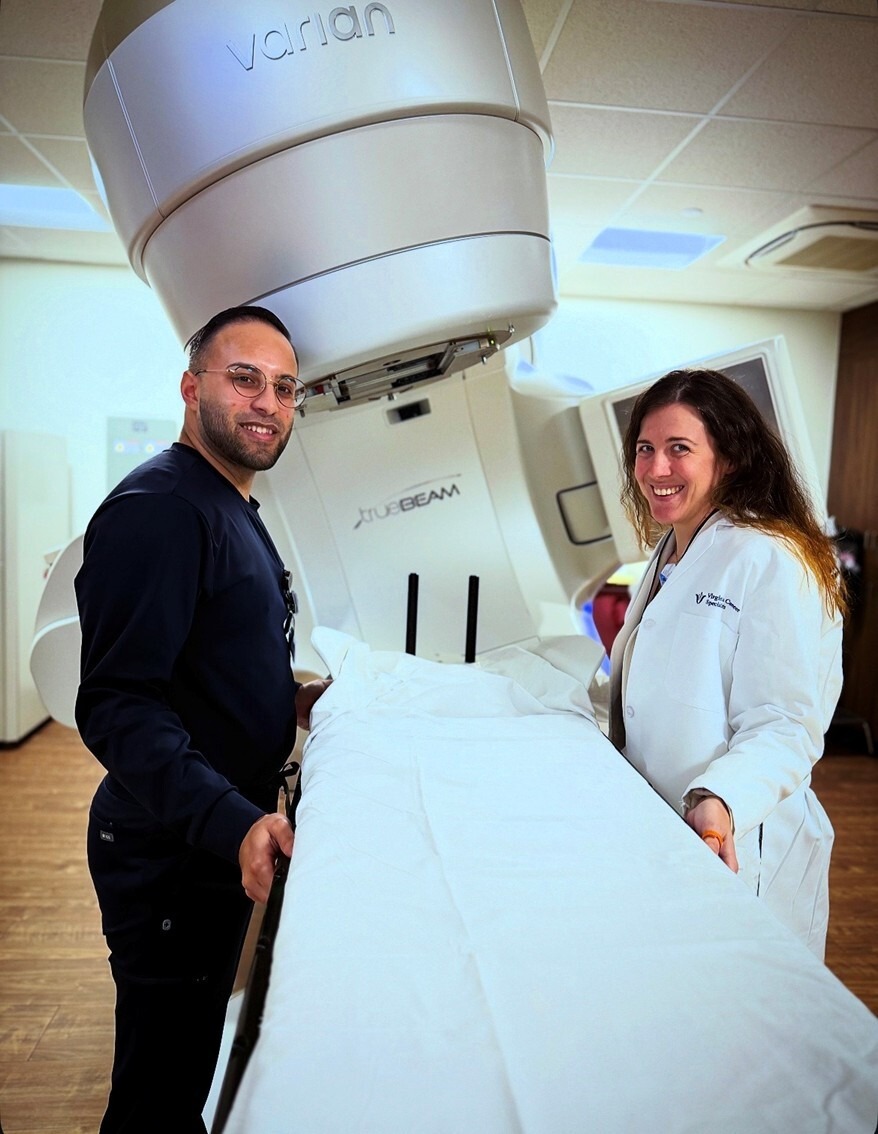
Benefits of TrueBeam™
• Faster Treatments: The TrueBeam™ system delivers radiation at a faster dose rate than traditional technologies. This speed translates to shorter treatment times for patients. Typical treatment times can be cut in half, with most taking under half an hour.
• Comfort: Quiet operation and shorter treatment times mean less stress for the patient.
• Precision Targeting: The precision of the TrueBeam™ system is measured in increments of less than a millimeter. This precision allows physicians to protect vital organs and healthy tissue surrounding the tumor.
• Personalized Care: TrueBeam™ makes it possible to tailor a patient’s treatments using a variety of methods, including respiratory gating, real-time tracking, imaging, and more.
• Visibility: The TrueBeam™ system produces 3-D images which allow doctors to target tumors precisely. It also reduces the number of x-ray doses a patient receives by 25%.
Accreditations
Virginia Cancer Specialists is accredited by the American Society for Radiation Oncology (ASTRO) Accreditation Program for Excellence (APEX) program, a significant achievement for a community cancer practice. ASTRO created the APEX program to recognize radiation oncology facilities that meet or exceed high standards of care. For a community cancer practice, APEX accreditation indicates a commitment to excellence not only in radiation therapy but also in following a patient-centered approach with demonstrated clear communication, empathy, and patient engagement designed for continuous improvement, all while agreeing to rigorous evaluation and peer review.
Virginia Cancer Specialists is recognized as a Radiopharmaceutical Center of Excellence by the Society of Nuclear Medicine and Molecular Imaging (SNMMI), which signifies demonstrated quality and expertise in the use of radiopharmaceuticals and adherence to rigorous guidelines and standards to ensure patient safety.
For inquiries about the Radiation Oncology Center at Virginia Cancer Specialists, call 703.934.4451.
Our Radiation Oncologists