One of the more common questions surrounding breast health is:
“My mammogram says I have dense breasts. Should I be worried?”
It’s a reasonable question. Nearly half of women who undergo screening mammography have dense breast tissue, yet many leave with more questions than answers.
Does dense breast tissue increase your risk of breast cancer? Does it mean a mammogram could miss something? Should you have additional imaging?
The reality is that dense breast tissue is important, but it is only one part of a much larger screening conversation. The best screening plan is one that is individualized based on your breast density, your overall risk factors, and your personal preferences.

What is breast density?
Breast density describes how much fibroglandular tissue is present compared with fatty tissue on a mammogram. Density can only be determined by having a mammogram. It cannot be determined by breast size, how your breasts feel on examination, or by self-examination.
Radiologists classify breast density into four categories:
- A: Almost entirely fatty
- B: Scattered areas of fibroglandular density
- C: Heterogeneously dense
- D: Extremely dense
Categories A and B are generally considered “non-dense,” while C and D are considered “dense.”
The single most common category is Category C (heterogeneously dense breasts), representing approximately 40% of women.
Why does breast density matter?
Dense breast tissue matters for two reasons.
First, women with dense breasts have a modestly increased risk of developing breast cancer compared with women with less dense breasts.
Second, and often more importantly, dense tissue can make breast cancers more difficult to see on a mammogram because both dense tissue and many breast cancers appear white on the image. This “masking effect” decreases the sensitivity of mammography.
It is important to understand that mammograms still save lives and still detect many breast cancers in women with dense breasts. Having dense breasts does not mean mammograms are ineffective. Rather, it means that mammography is somewhat less sensitive than it is in women with predominantly fatty breasts.
Should every woman with dense breasts have additional screening?
Not necessarily.
This is one of the most common questions breast surgeons are asked, and there is no single answer that is right for every woman.
Additional screening may increase the likelihood of detecting cancers that are not visible on a mammogram. However, it also increases the chance of false-positive findings, additional imaging, biopsies, anxiety, cost, and uncertainty.
For many women, those tradeoffs are worthwhile. For others, they are not.
The decision should be individualized after considering:
- Breast density
- Personal risk factors
- Family history
- Prior breast biopsies
- Age
- Personal preferences
- Tolerance for uncertainty
- Insurance coverage and financial considerations
What additional screening options are available?
Several supplemental screening tests may be appropriate depending on an individual’s situation.
Whole-breast ultrasound
Whole-breast ultrasound can identify some cancers that are not visible on mammography, particularly in women with dense breasts.
However, ultrasound has important limitations. It has relatively high false-positive rates, leading to additional testing and biopsies that ultimately prove benign. Ultrasound can also miss cancers that MRI would detect.
For some women, ultrasound is an appropriate supplemental study, particularly when MRI is not feasible or available.
Abbreviated breast MRI
Abbreviated breast MRI is a shorter version of a standard breast MRI that has emerged as an effective supplemental screening option.
Many studies have shown that abbreviated MRI detects substantially more breast cancers than mammography alone, including cancers that may not be visible on mammography because of dense breast tissue.
The American College of Radiology now recognizes abbreviated breast MRI as a reasonable supplemental screening option for many women with dense breasts, particularly when individualized risk assessment supports additional screening.
Insurance coverage continues to evolve, and out-of-pocket costs vary.
Full-protocol breast MRI
Full breast MRI remains the most sensitive breast imaging test available.
It is commonly recommended for women at substantially increased lifetime risk for breast cancer, but it may also be appropriate for selected women with dense breasts after individualized discussion.
Doesn’t dense breast tissue also make MRI difficult?
Not necessarily.
MRI is different from mammography.
Instead of breast density, MRI is affected by something called background parenchymal enhancement (BPE), which reflects how much normal breast tissue enhances after contrast administration.
Some women have marked background enhancement, which can make MRI interpretation more challenging.
However, many women with dense breasts have only minimal or mild background enhancement, allowing MRI to detect cancers that might remain hidden on mammography.
Breast density and background enhancement are related but are not the same thing.
Hormonal influences, including hormone replacement therapy, can increase background enhancement in some women, although many women naturally have higher or lower levels regardless of medication use.
What about my breast cancer risk?
Breast density is only one piece of the puzzle.
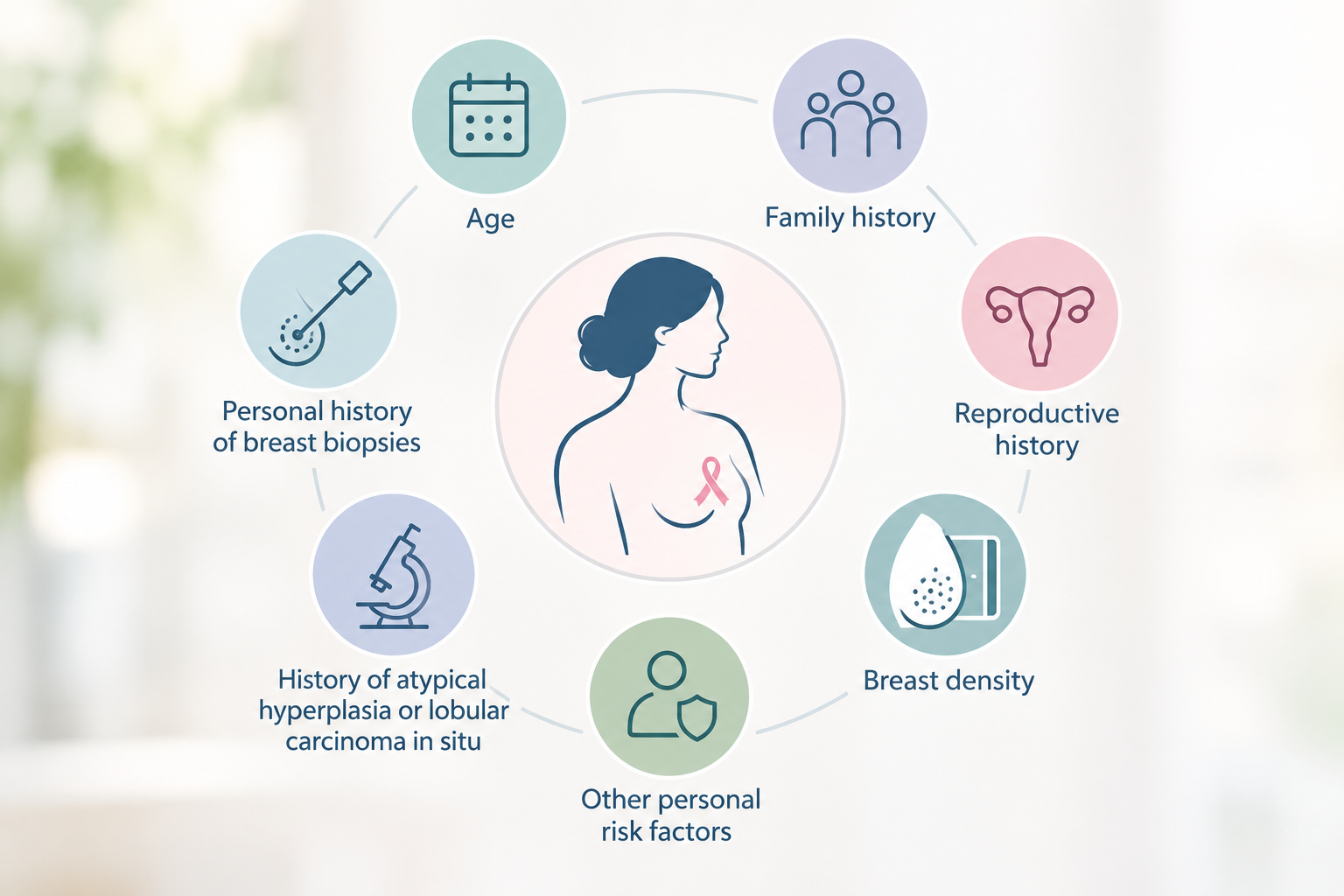
A woman’s overall breast cancer risk depends on many factors, including:
- Age
- Personal history of breast biopsies
- History of atypical hyperplasia or lobular carcinoma in situ
- Family history
- Reproductive history
- Breast density
- Other personal risk factors
Several validated online calculators help estimate breast cancer risk.
The two most commonly used are:
- The Gail Model Breast Cancer Risk Assessment Calculator – NCI
- The Tyrer-Cuzick (IBIS) Model Tyrer-Cuzick Risk Calculator for Breast Cancer Risk Assessment | MagView and The Tyrer-Cuzick Model: Understanding the Assessment and Your Breast Cancer Risk – National Breast Cancer Foundation
These calculators are available free online and can provide a helpful estimate of risk.
However, the calculations depend on entering the correct information. Certain variables can substantially change the estimated lifetime risk, and some questions can be confusing. For that reason, many women benefit from reviewing these risk models with a clinician familiar with breast cancer risk assessment.
What if my genetic testing was negative?
Many women assume that negative genetic testing means they are at average risk.
That is often not the case.
Most women who develop breast cancer do not carry an identifiable hereditary mutation.
Likewise, many women with negative genetic testing remain at elevated risk because of other personal risk factors.
Conversely, some women without any family history of breast cancer still have an increased lifetime risk.
Being female and having breast tissue remain the greatest overall risk factors for developing breast cancer.
Family history and genetic testing are important pieces of the puzzle, but they do not tell the entire story.
So, what should you do?
If your mammogram reports dense breast tissue, don’t panic.
Dense breasts are common.
Continue getting your recommended mammograms.
If you have questions about whether additional screening might be appropriate, consider discussing your individual risk with a breast specialist or another clinician experienced in breast cancer risk assessment.
For some women, annual mammography alone remains the best strategy.
For others, supplemental ultrasound or breast MRI may provide meaningful additional reassurance and earlier detection.
What Questions Should I Ask?
If you’ve been told you have dense breast tissue, consider asking your healthcare team:
- What breast density category am I?
- Based on my overall risk, should I consider supplemental screening?
- Would ultrasound or MRI be appropriate for me?
- What is my estimated lifetime risk of breast cancer?
- Does my family history increase my risk?
- How do my genetic testing results factor into my screening recommendations?
These questions can help move the discussion from generalized recommendations toward a screening plan that is tailored to you.
The goal is not to perform every available test. The goal is to choose the screening strategy that best fits your individual risk, your personal preferences, and your comfort with uncertainty.
At Virginia Cancer Specialists, we believe breast cancer screening should be personalized. We are happy to help women understand their breast density, estimate their individual risk, review available screening options, and develop a surveillance plan that is right for them.